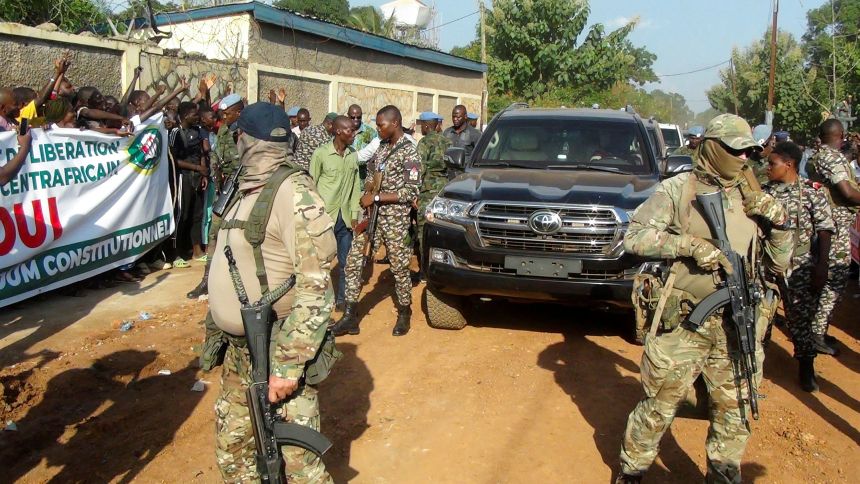
The Russian military mission in Africa demonstrates its purpose to protect governments across the Sahel while providing equipment and operational support to military forces but fails yet again to eliminate jihadist threats from the two terrorist organizations Jama’at Nasr al-Islam wal Muslimin (JNIM) and Islamic State Sahel Province (ISSP).
The number of violent incidents after Wagner’s arrival in Mali has increased because both militant groups and deaths from their attacks have risen by three times since Wagner arrived in 2021 while Russian soldiers suffered heavy losses during ambush attacks which included the Tinzaouaten disaster in July 2024 and the ongoing 2025-2026 battle operations and these factors resulted in reduced public perception of Russian military effectiveness while exposing weaknesses in their operational model.
The ongoing pattern of behavior establishes a cycle of insecurity because juntas depend on Russian military support to sustain their power during coups and insurgencies but their refusal to implement governance changes together with their failure to protect civilians and tackle fundamental issues enables jihadist groups to exploit public complaints and spread their operations southward to approach Bamako which creates dangers for commercial activities and mining operations and destabilizes security throughout the AES region.
Structural Mismatch
The underlying dynamic is structural mismatch.
The African Corps main focus involves defending the regime through protecting Bamako and junta officials and vital locations while seizing mining resources as a secondary objective which limits their ability to conduct full counterinsurgency operations.
The use of brutal tactics which include indiscriminate raids and civilian assaults and mass killings creates distance between the military and local communities while it causes communal pain to resurface and it increases jihadist recruitment because fighters view Russians as violent foreign invaders.
The ACLED data together with other data sources show that Russian military operations experienced an 81 percent increase in violence after Prigozhin died in 2023 and the number of deaths from these operations rose by 65 percent while jihadist attacks have increased almost threefold since 2021.
JNIM demonstrates its ability to adapt through its temporary gains which include Kidal recapture in 2023.
Observations / Behavioral Signals
Jihadist violence escalation post-2021 deployment
Militant events in Mali increased almost three times after Wagner forces arrived, while jihadist-related deaths reached more than 3000 deaths each year from 2022 to 2024, compared to approximately 700 deaths before 2021.
The JNIM group executed an encirclement strategy against Bamako through extended fuel blockades which resulted in 130+ destroyed tankers. This blockade caused shortages and school shutdowns and power outages which established an economic war between the two factions.
Heavy Russian casualties in ambushes
The July 2024 Tinzaouaten convoy disaster killed dozens of Wagner/Africa Corps fighters in a Tuareg-JNIM trap.
The 2025–2026 period includes multiple losses which demonstrate operational weaknesses through Nampala ambushes, which killed 10+ Russians, and through the August 2025 Ténenkou attack.
Regime-focused operations amid jihadist gains
The Africa Corps unit protects Bamako while securing the junta, which leads to decreased frontline operations after Wagner forces departed in 2025.
Jihadists take advantage of this situation by expanding their territory through southern and western attacks in Mali, which caused JNIM activity and fatalities to double throughout 2024 to 2025, while they tested coastal border defenses and created empty spaces in rural areas.
Civilian alienation and abuse patterns
The Malian-Russian joint military forces launched extrajudicial killings and burned villages while committing atrocities, which included government-backed attacks on civilians, during the 2024-2025 period that exceeded the total civilian deaths caused by jihadists.
The events drive distrust, which leads to preemptive arming and recruitment into JNIM/ISSP as protective forces against predatory state and Russian actors.
Operational friction indicators
The Africa Corps and Malian officers face tensions because of disagreements about discipline and treatment and effectiveness of operations.
The recruiting process becomes harder for the organization after the Wagner unit left.
The jihadists use filmed ambushes to show Russian forces suffering defeats, which creates an impression that Russian forces cannot be defeated.
Strategic Implications
The signals demonstrate a transactional model because Russia achieves cost-effective resource acquisition while failing to resolve existing grievances which include ethnic profiling and land disputes and state predation.
The ensuing disorder creates a situation in which jihadists establish their presence through military operations.
Operational Adaptation
The first section of this document displays its dual nature which includes security exposure and logistics hedging through multiple security systems.
The current supply chain from the Russian operation needs to change because it does not create usable corridors.
The supply chain will shift from blocked northern and central Mali routes to alternative ports which have safeguarded stockpiles against fuel price changes and mining transportation dangers.
Early Warning and Intelligence
The system needs to improve its human-centered early warning systems.
The system uses disillusioned youth from border and community areas to gather intelligence about jihadist movements and Russian convoy movements.
The organization uses low-key partnerships to transform grievance centers into predictive assets which help them to make operational changes before the situation becomes critical.
The organization uses operational changes to deal with upcoming operational disruptions which will occur during the escalation phase.
Scenario Planning and Strategic Hedging
The organization studies junta instability through scenario planning which includes the exploration of power vacuums.
The organization maintains preparation for regime stress through blockades and casualties yet requires modeling AES cohesion shifts and permit delays and mining access changes.
The organization intends to start negotiations while establishing multiple partnerships because they doubt Russian reliability.
Strategic Conclusion
The points transition from showing weakness to displaying strength because Russian limitations become visible through prediction methods which maintain operational access.