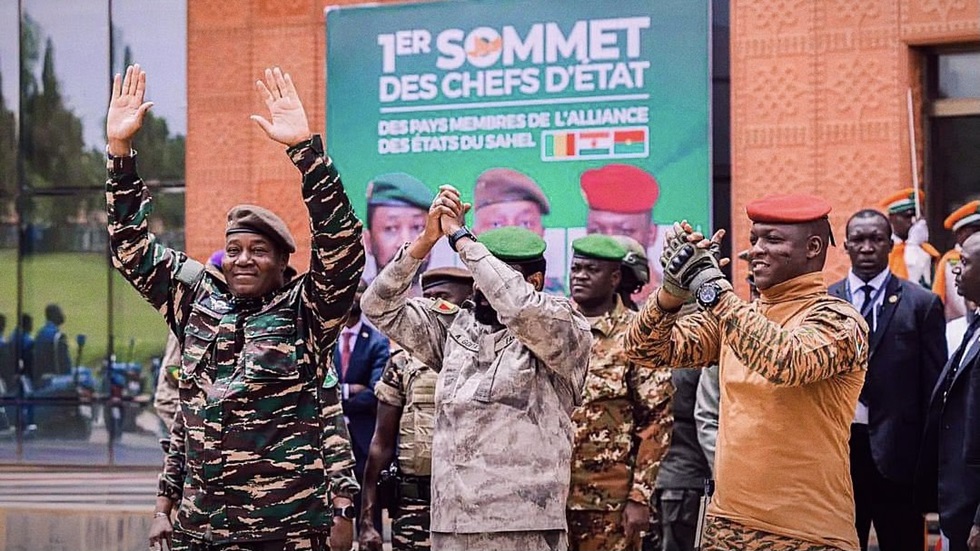
The AES Pact demonstrates that western nations struggle to maintain their control over the Sahelian region because they face multiple internal conflicts while their rural areas experience security challenges.
The Alliance of Sahel States (AES), which consists of junta-led Mali, Burkina Faso, and Niger, has established itself as a confederation that operates with a 6000-member Unified Force. This force started operations in December 2025 from its Niamey base and engages in joint defense activities while following its anti-Western policy by expelling French and U.S. military forces and acquiring Russian military equipment and training, with restricted support from Africa Corps.
The system enables two nations to operate with greater control through better management of border activities while hiding its internal issues, which arise from different military priorities between factions that lack equal access to resources and other military challenges that result from self-funded operations through an import fee. These challenges create security gaps that allow jihadist organizations such as JNIM and ISSP to move freely, wage economic warfare through fuel blockades and taxation, and attack major urban centers.
The AES system enables juntas to obtain political independence from ECOWAS and Western powers while maintaining their authority, which requires them to establish functioning political systems that address community needs. Without these, jihadist groups can take control of vital mining areas and trade routes, causing people to flee their homes and creating problems in neighboring countries such as Benin and Togo.
Historical Context and Structural Dynamics
The main conflict exists between two opposing forces, which represent human ambition and human ability to achieve. The AES started as a mutual defense agreement between two nations formed in 2023 during the ECOWAS sanctions and coup events. It transformed into a confederation from 2024 to 2025, which included biometric passports, a planned shared parliament, and a common economic development treaty that included a telecom satellite partnership with Russia.
The Unified Force uses NATO-style coordination as its main operational model, enabling it to combine military forces for missions such as the tripartite Yereko operations. However, the organization suffers from G5 Sahel’s persistent funding shortages, which continue despite funding commitments. It depends on unpredictable Russian assistance, which provides strong support to Mali but weak support to Burkina Faso and Niger, and it lacks a complete air support system and intelligence infrastructure.
Jihadists use rural regions as operational bases: JNIM surrounds Bamako through its 2025–2026 military blockades, while ISSP conducts border testing operations. Military juntas prioritize maintaining power over protecting public safety. Russia supplies military power to support their operations but fails to deliver the necessary changes to stop the recruitment of former soldiers with combat injuries and address absent governance systems. This makes the alliance susceptible to internal conflicts arising from resource competition and power struggles among military leaders.
Observations / Behavioral Signals
- Jihadist control in rural areas: Although AES launched their operations, jihadist groups in rural areas have achieved greater control. JNIM has maintained fuel blockades in Mali since 2021, destroying more than 130 tankers, which creates supply shortages, blackouts, and school closures. These patterns from Burkina Faso and Niger demonstrate that rural areas beyond junta and AES control remain active.
- Limited Unified Force capacity: The Unified Force started with 6000 soldiers in December 2025, yet its operations, including Yereko 2 operations, have not stopped jihadist expansion. From 2025 to 2026, attacks increased while JNIM and ISSP operated with mobility throughout the Liptako-Gourma tri-border areas and southern regions, resulting in empty communities and the displacement of millions.
- Russian military operations: Russian operations occur in two ways across Africa. The African Corps operates primarily in Mali, conducting combat operations and providing equipment, while offering only training support to Burkina Faso and Niger. Frictions arise from three sources: Mali’s military resentment about preferential treatment, Niger’s 2025 intelligence-sharing halts with Russia/Turkey, and overall failure to disrupt jihadist networks. Violence trends upward after increases in support.
- Internal confederation strains: Divergent junta priorities (e.g., Mali’s deeper Russian embed vs. Burkina/Niger’s lighter ties), funding shortfalls despite levies, and accusations of unequal benefits mask unity. Rotating presidency (Burkina Faso in 2026) highlights coordination challenges amid economic pressures and the ECOWAS divorce.
Governance and Rural Security Challenges
Reports about junta and AES-connected activities—including extrajudicial killings and reprisal attacks in rural areas—trigger psychological distress. People acquire weapons and join jihadist groups as protectors, while governmental authority decreases.
Governing bodies lose control over border regions because AES protection promises fail to deliver actual security. The agreement shows its unbalanced nature through two elements: it supports anti-Western military backing but fails to provide adequate security for rural areas.
Three Ways This Could Liberate Agility
- The system will convert educational unity into measurable rural exposure variables by tracking Islamic movement activities during Unified Force AES operations. This enables secure route creation through active stockpile management in previously unknown territories.
- The system will reveal internal conflicts within the federation to assist decision-making through tracking funding, Russian military activities, and failed rural security efforts. This enables clients to find new access methods, conduct negotiations with local entities, and determine influence before jihadist forces gain full control.
- The system enables organizations to transform existing treaty restrictions into flexible strategic advantages by leveraging support differences and rural security weaknesses. This establishes strong networks, including multiple supply chain routes, human-centered monitoring systems, and operational defense capabilities.
Strategic Assessment
The AES represents Sahelian resistance against Western powers through its combination of anti-Western activities, self-funded goals, and united political statements that contest ECOWAS and Western power structures.
Rural core areas face risks because Russian military strength remains weak, financial resources are scarce, and junta factions pursue separate agendas. Jihadists take control of vacant regions and commercial routes, undermining governmental authority.
Operators and investors require complete understanding of the actual state of affairs. While the agreement provides immediate protection to governments, it creates long-term danger due to a lack of trauma-informed methods and inappropriate security solutions.
The process of agility enables organizations to establish future patterns by monitoring operational fractures, protecting rural territories, and engaging with peripheral areas. This approach helps manage challenges when alliances show signs of internal discord.