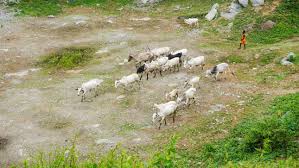
The Sahel region experiences increased risk through erratic rainfall patterns and desertification, creating land pressure challenges that heighten resource conflicts between competing groups. Central Mali has seen ongoing clashes between Dogon farmers and Fulani herders, starting in 2018 and continuing through 2026.
Environmental stressors interact with governance failures—including weak state mediation, collapsed customary institutions, ethnic profiling, and junta-focused security that neglects rural protection—to create seasonal violence. Adaptation efforts such as land enclosures, water projects, and agricultural expansion, implemented without proper community involvement and trauma-informed approaches, exacerbate tensions. Herders view these efforts as barriers restricting movement, while farmers consider them insufficient for protecting crops.
Jihadists from JNIM and ISSP exploit these grievances to recruit new members, offering protection. Climate thus functions as a conflict trigger, amplifying vulnerabilities through displacement—almost 4 million people in central Sahel by late 2025—food shortages, jihadist movements into rural areas, and security threats that extend to southern regions and coastal West Africa, including Benin and Togo.
Mechanisms of Climate-Conflict Interaction
The mechanism operates on multiple levels:
- Sahel temperatures increase at 1.5 times the rate of global temperature rise.
- Rainfall patterns are irregular, with shorter wet seasons and extended droughts.
- Desertification renders approximately 80 percent of farmland unproductive, decreasing available grazing and farmland amid a growing population.
Traditional transhumance corridors have shrunk as farmers move north to secure food, trampling existing pathways and encountering blocked areas, resulting in revenge killings. Governance vacuums appear when post-coup juntas focus on regime protection rather than resolving rural conflicts. Russian/Africa Corps safeguard cities, while customary elders lose authority.
Environmental stress triggers communal trauma: Fulani perceive enclosures and profiling as threats to mobility and dignity, while Dogon view cattle incursions as attacks on ancestral territory. Jihadists leverage predictable taxation systems, route security measures, and anti-state narratives to establish recruitment pipelines emerging from resource conflicts.
Recent 2025–2026 studies show Fulani-opposition violence increasing by over 60 percent through episodes like Dan Na Ambassagou clashes, with climate shocks displacing thousands and creating cycles of movement in Mopti/Bandiagara regions.
Observations / Behavioral Signals
- Extended dry weather (2024–2025): Forces Fulani herders to migrate southward, leading to conflicts with Dogon farmers. Livestock deaths reach 40 percent during extreme conditions, prompting communities to establish borders and increasing violent incidents in Mopti (2018–2026).
- Farmer northward migration: Population and climate changes create land pressure. Dogon communities build fences and expand fields, perceived by Fulani as land appropriation, leading to crop destruction, militia formation, and Dan Na Ambassagou attacks on Fulani villages.
- State and junta security failures: Raids and military monitoring fail to resolve disputes, creating distrust. Herders align with JNIM for operational support while accusing enemies of genocide.
- Jihadist mediation: In areas of heightened stress, jihadist organizations provide mediation and tax collection where government control is absent. 2025–2026 studies indicate increased Fulani recruitment into JNIM due to profiling and denied resource access, escalating dual-faceted insurgent warfare.
- Displacement and spillover effects: Climate-conflict dynamics produce empty villages across Burkina Faso, northern Mali, and western Niger. UN 2025 warnings cite 4 million displaced persons, generating cascading effects such as earlier hunger seasons and southward migration into Benin and Togo via unguarded national parks.
Operational Implications
Climate conditions act as an acceleration force: environmental stress, governance absence, and traumatic experiences underpin deadly conflict cycles.
Proactive measures include:
- Corridor and supply chain diversification: Address climate-induced blockages affecting transhumance and highways by redirecting mining and transport toward less congested routes and coastal ports, providing defenses against attacks and fuel price volatility.
- Community-based early warning systems: Partner with herder and farmer organizations in land-pressure areas. Transform grievance hotspots—including enclosure disputes and profiling—into predictive intelligence without revealing sensitive data.
- Trauma-sensitive scenario planning: Prepare for disruptive events, including permit and access interruptions and recruitment growth, by building multiple local connections and promoting shared conflict resolution methods to reduce militancy threats.
These flex points create agile operations, enabling organizations to predict expansion effects while managing multiple priorities and resources to maintain control over conflicts that could escalate.
Three Ways This Could Liberate Agility
- Convert environmental stress signals into operational adjustments: Monitor rainfall, migration shifts, and enclosure reports. Shift from reactive route closures toward proactive rerouting and stockpiling. Treat climate-multiplied tensions as manageable variables to maintain business operations.
- Track governance-climate relationships: Identify adaptation failures, particularly top-down enclosures that create jihadist-exploitable vacuums. Use safe passage negotiations to develop operational margins before conflict cycles deepen.
- Transform resource exposure into strategic advantage: Build resilient networks using trauma-informed monitoring of farmer-herder dynamics. Maintain access and operational stability in governance-vacant Sahel regions.
The Sahel functions as a climate threat multiplier, increasing instability through rainfall variability, desertification, and land pressure. Operational investors can track essential indicators and environmental changes through a unified system, while trauma-sensitive adaptation strategies are necessary to prevent climate shocks from driving further militancy. Each drought, enclosure, and unresolved clash represents a compounding risk to regional stability.