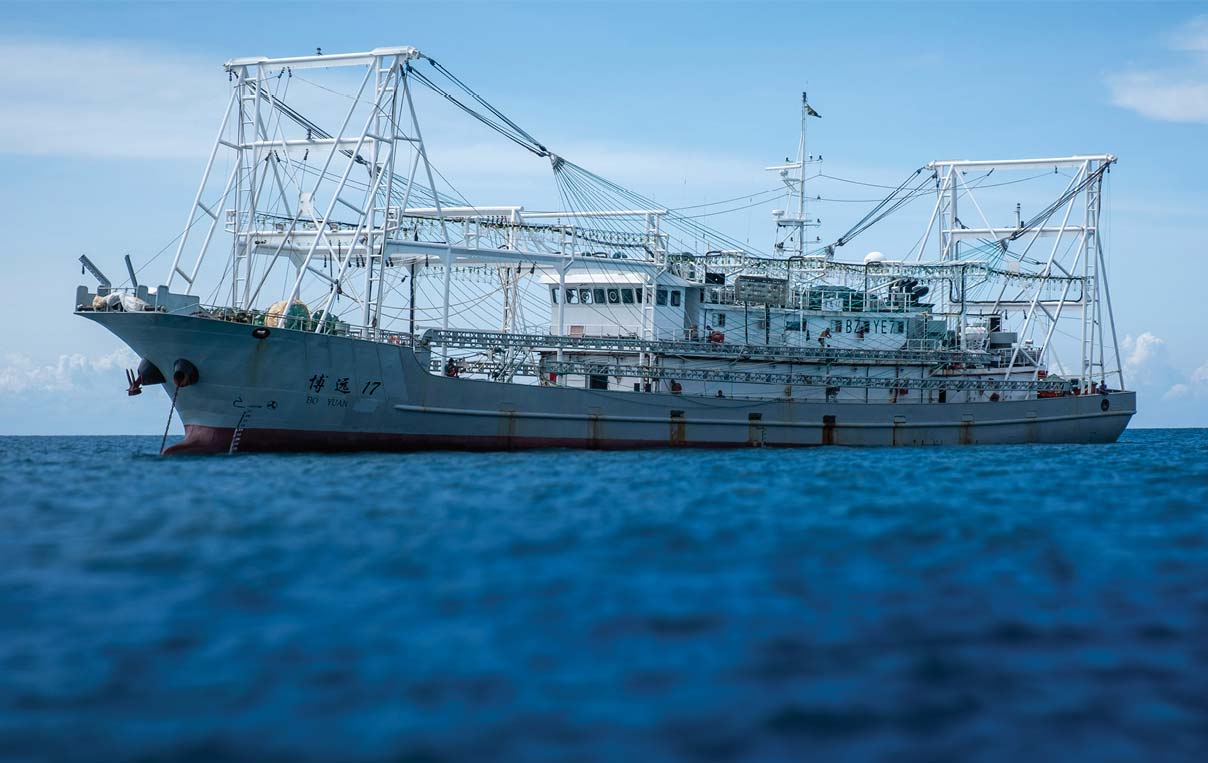
IUU Fishing in West African Waters: A Structural Driver of Maritime Insecurity
1. Situation
Illegal, Unreported and Unregulated (IUU) fishing remains one of the most persistent and systematically underaddressed maritime security challenges across the Gulf of Guinea and broader West African waters. Coastal states — including Ghana, Sierra Leone, and Nigeria — continue to sustain significant losses in fish stocks and associated revenue as a consequence of unauthorised industrial fishing activity operating within or adjacent to their exclusive economic zones.
Foreign-operated trawlers, frequently functioning under opaque and deliberately obscured ownership structures, account for a disproportionate share of documented illegal fishing activity in the region. Their continued operation is enabled by weak enforcement capacity, regulatory inconsistency, and, in several instances, institutional vulnerabilities that allow violations to go unaddressed over extended periods.
2. Pattern
Observable patterns across the region point to a set of recurring and interconnected behaviours that characterise IUU fishing operations:
- Industrial vessels routinely encroach into inshore exclusion zones legally reserved for small-scale and artisanal fishers, directly displacing local fishing activity
- Systematic manipulation or deliberate disabling of Automatic Identification System (AIS) transponders, creating intentional gaps in vessel tracking and maritime domain awareness
- Utilisation of local front companies and flag-of-convenience arrangements to obscure beneficial ownership and complicate enforcement and legal accountability
- Repeated violations by the same operators, in the absence of meaningful enforcement consequences, reflecting a permissive operating environment
While IUU fishing is not always categorised within conventional maritime crime typologies, its cumulative effect constitutes a persistent, low-visibility security threat. It progressively erodes state authority over coastal waters and generates the socio-economic conditions from which more acute forms of maritime insecurity emerge.
3. Drivers
Three structural drivers underpin the persistence and scale of IUU fishing activity across West African waters:
Weak Maritime Enforcement Capacity The naval, coastguard, and surveillance resources available to most West African coastal states remain inadequate relative to the scale of monitoring and interdiction required. Limited patrol coverage, insufficient aerial or satellite surveillance integration, and constrained interagency coordination collectively reduce the probability of detection and enforcement — a calculus that operators exploit.
High Global Demand for Fish Protein Sustained and growing international demand for fish — particularly from markets in Asia and Europe — creates powerful economic incentives for aggressive extraction practices. Where legal channels are insufficient to meet demand profitably, illegal and unreported fishing fills the gap, underpinned by supply chains that absorb illegally caught product with limited transparency or accountability.
Governance and Regulatory Gaps Inconsistent licensing regimes, insufficient port-state controls, corruption risks within enforcement and regulatory institutions, and the absence of harmonised regional standards collectively produce an environment in which IUU operators can function with relative impunity. These gaps are not incidental — in many instances they are structurally embedded and require institutional reform rather than operational response alone.
4. Implications
The consequences of sustained IUU fishing activity extend well beyond environmental degradation, carrying direct implications across economic, security, and governance dimensions:
- Economic Losses: West African coastal states collectively lose billions of dollars annually in unrealised revenue, depleted fish stocks, and foregone economic activity — resources that would otherwise support public services, infrastructure, and coastal development
- Livelihood Disruption: Artisanal and small-scale fishing communities bear a disproportionate burden, facing declining catches, compressed incomes, and deteriorating food security as industrial encroachment reduces the viability of subsistence and small-scale commercial fishing
- Security Spillover: Economic hardship and loss of legitimate livelihood in coastal communities create conditions of heightened vulnerability to recruitment into illicit networks — including smuggling operations, piracy support roles, and other criminal maritime activities
- Erosion of State Authority: The persistence of illegal activity in the absence of effective response progressively undermines institutional credibility, public confidence in maritime governance, and the perceived legitimacy of enforcement institutions
5. Outlook
IUU fishing across West African waters is assessed as likely to remain structurally entrenched in the near to medium term. The conditions sustaining it — enforcement deficits, governance gaps, and sustained external demand — are not amenable to rapid resolution and will require sustained, coordinated intervention to address meaningfully.
Absent significant and coordinated improvements across three critical areas — maritime domain awareness, enforcement coordination among coastal states, and regulatory transparency — the regional trajectory points toward:
- Continued and accelerating depletion of marine resources, with long-term consequences for food security and coastal economies
- Deepening socio-economic stress in fishing-dependent communities, increasing their susceptibility to exploitation by criminal and armed networks
- A growing convergence between economic crime and broader maritime insecurity, as the boundaries between IUU fishing, smuggling, and organised criminal activity become increasingly difficult to distinguish operationally
6. Bottom Line
IUU fishing in West Africa must not be framed as a peripheral environmental or fisheries management concern. It is a foundational driver of maritime insecurity, with direct and demonstrable consequences for regional stability, governance integrity, and long-term risk trajectories across the Gulf of Guinea.
Effective risk assessment and policy response in this domain require its treatment not as a secondary issue but as a core component of the maritime security architecture — one whose resolution is prerequisite to any durable improvement in the broader security environment.
AfriSahel Risk Intel | www.afrisahel.com